
Allegheny County Court Records After Arrest
The arrest to court path in Allegheny County usually runs from police arrest to booking or intake, then to arraignment, bail review, preliminary proceedings, prosecutor review, and a docketed court case. The Allegheny County District Attorney prosecutes Pennsylvania-law offenses in the county. Federal offenses follow a different court system and should not be mixed into a county criminal docket search.
Jail records and court records after a jail arrest answer different questions. Jail staff can confirm custody, booking date, pod, release, or transfer information when the official channel allows it. The court record shows charges filed in court, docket events, bail, dispositions, and future or past hearing information. For current custody details, use Allegheny County jail inmate records. For booking photo questions, use Allegheny County jail mugshots.
Search Allegheny County Court Records
The main online court channel is Pennsylvania UJS Case Search. The UJS portal provides free public docket sheets for Pennsylvania courts, including Magisterial District Court and Court of Common Pleas matters when the record is public and within the system’s access rules. Allegheny County cases may be searched by name, docket number, OTN, and other search modes available in the portal.
- Open UJS Case Search and choose the search type that fits the information available.
- Use Allegheny County as a filter when the search mode allows it, especially for common names.
- Open the matching result and choose the docket sheet to review charges, events, bail, and disposition entries.
- Compare the docket to jail custody information before assuming the person is still held at Allegheny County Jail.
The Allegheny County District Attorney court-case lookup guide gives a local OTN method. It tells users to choose OTN in UJS, enter the Offense Tracking Number from the preliminary hearing, search, then open the docket sheet through the result action. The guide also warns that a computer record can take about two to four weeks from the preliminary hearing to be generated.
Allegheny County Case Search Fields
Good court records after arrest searches depend on the identifier. A full name may work, but a docket number or OTN is cleaner when it is available from paperwork, a preliminary hearing, or the DA’s victim-facing lookup instructions.
| Field Label | Type | Required | Notes |
|---|---|---|---|
| Search Type | Dropdown | Yes | The DA guide uses OTN, while UJS supports other modes. |
| OTN | Text | Required for OTN search | Offense Tracking Number from preliminary hearing materials. |
| Participant or Defendant Name | Text | Depends on search type | Use full name and narrow by county when possible. |
| Docket Number | Text | Depends on search type | Best when known from court paperwork. |
| County | Filter | Optional by mode | Use Allegheny County to reduce statewide matches. |
Allegheny County Court Portal Sources
The Pennsylvania UJS Case Search portal is the statewide online court-record source for docket sheets and case entries after an Allegheny County arrest.
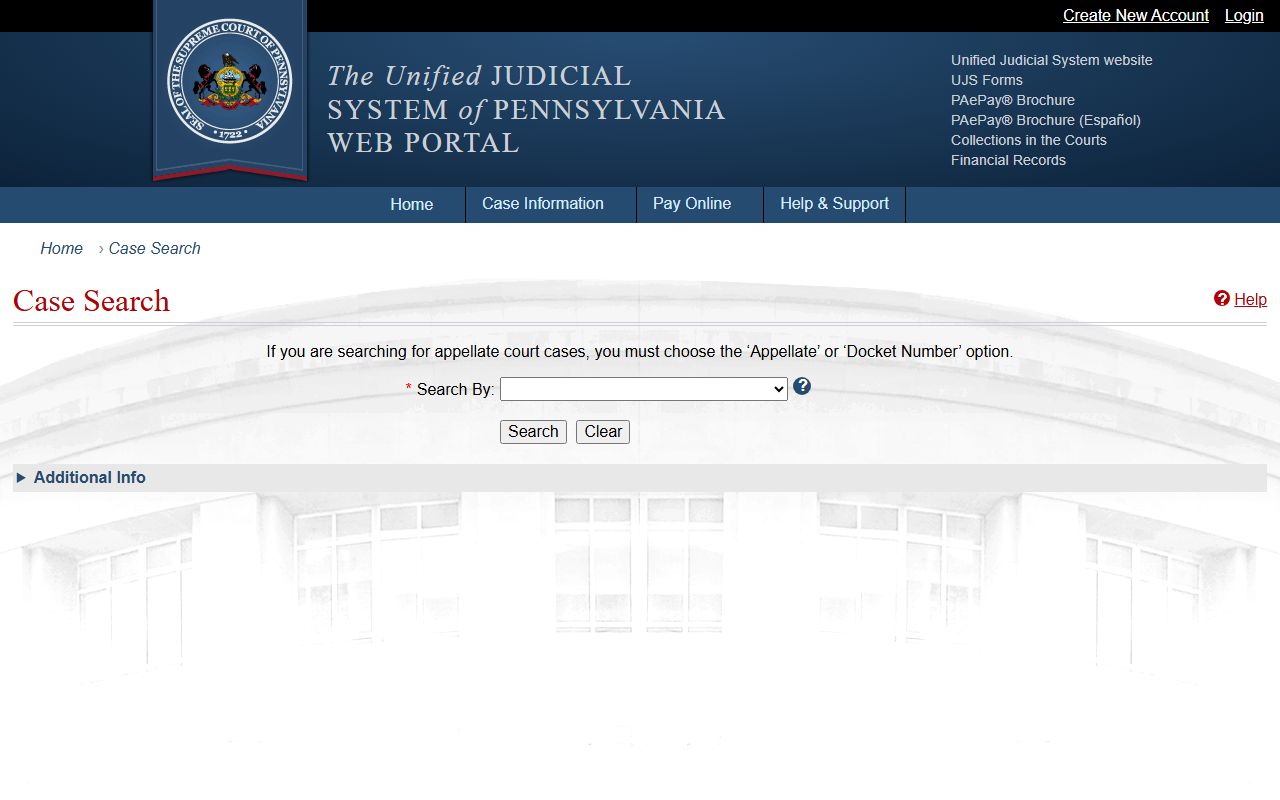
Use UJS for case information, then confirm custody through the jail if the question is whether the person remains in custody.
Charges Filed After Arrest
Charges can change after arrest. Police paperwork, jail intake information, prosecutor filings, and final court outcomes may not match word for word. The court record after a jail arrest is the place to track the case as it moves. A charge is an accusation. A conviction requires a plea or verdict and a court judgment.
| Document | Who Uses It | What It Does |
|---|---|---|
| Criminal complaint | Police or prosecutor | Starts or supports the initial charge path in many Pennsylvania cases. |
| Information | Prosecutor | Lists charges the prosecutor files in Common Pleas after preliminary proceedings. |
| Indictment | Grand jury or federal process | May be used in serious or federal matters, which are separate from ordinary county docket searches. |
Allegheny County Charge Status
A court docket can show that a charge is pending, withdrawn, dismissed, amended, held for court, reduced, or disposed. The precise wording depends on the court entry. Always read the docket sheet as a timeline because one entry may affect only one charge while other counts continue.
| Status | Plain Meaning |
|---|---|
| Pending | The charge is still active and has not reached a final outcome. |
| Held for court | The charge moved beyond the preliminary stage toward Common Pleas proceedings. |
| Amended or reduced | The charge language, grade, or count changed after review or agreement. |
| Dismissed or withdrawn | That charge is no longer moving forward, though other counts may remain. |
| Disposition entered | The docket reflects an outcome such as plea, verdict, dismissal, or sentence entry. |
Allegheny County Court Records Office
The Allegheny County Criminal Records page places criminal case-file access at the courthouse rather than the jail. Current year plus four prior years are kept in Room 220. Older files can be ordered from storage. Computer terminals are available for research, but the county page says case-related information is not discussed by phone.
Department of Court Records, Criminal Division
Allegheny County Courthouse
436 Grant Street, Room 114
Pittsburgh, PA 15219-2469
412-350-5323
Office hours: Monday-Friday, 8:30 a.m.-4:30 p.m., except county holidays.
Allegheny County District Attorney
Room 303 Courthouse
436 Grant Street
Pittsburgh, PA 15219
412-350-4401
Led by District Attorney Stephen A. Zappala Jr.
Bond After Allegheny County Arrest
Bond and bail information may appear in UJS and can also be checked through County Municipal Court or Arraignment Court at 412-350-3240. The research notes that menu options include arraignment times, bail amount, PFA, and release information. A bond entry does not guarantee release if a detainer, probation or parole hold, other-county warrant, federal hold, or ICE detainer blocks release.
| Release Term | What It Means |
|---|---|
| Cash or monetary bail | Money must be posted under the court’s terms before release can occur. |
| Unsecured bail | The person promises to appear and owes the amount only after a violation. |
| ROR | Release on recognizance means release based on a promise to appear. |
| Detainer or hold | Another authority has a claim that may keep the person in custody. |
The jail funds page adds a local detail: an incarcerated person can send trust funds to a third party within 10 days of booking, including family, an attorney, or bond. After 10 days, third-party send-outs are limited to attorney or bond payment.
Warrants and Court Records After Arrest
The Allegheny County Sheriff’s Warrant Office is the repository for criminal bench warrants issued by the Court of Common Pleas, Criminal Division. The sheriff’s FAQ gives the Warrant Office number as 412-350-4714 and says it is reachable at all hours. The sheriff’s public materials also note that authorized law-enforcement and criminal-justice agencies use NCIC/CLEAN access, not a general public warrant-search form.
CRIMEWATCH Allegheny County can show participating police-department wanted, warrant, arrest, and case posts, and the CRIMEWATCH Mobile app includes arrests, wanted posts, maps, tips, and notifications. It is not a complete Allegheny County Sheriff warrant database and it is not the jail roster.
Charges vs Convictions
Allegheny County court records after an arrest can show charges long before guilt is decided. A charge is an accusation filed or pursued in court. A conviction is the result of a guilty plea, verdict, or other final adjudication that establishes guilt for that offense.
| Charge | Conviction | |
|---|---|---|
| Stage | Filed during the case | Entered after plea, verdict, or adjudication |
| Meaning | Accusation | Legal outcome |
| Can change? | Yes, it may be amended, dismissed, or reduced | Changes usually require later court action |
Sealed and Expunged Arrest Records
Dismissal, withdrawal, acquittal, or diversion does not always erase a public docket by itself. Pennsylvania has separate sealing, limited access, and expungement procedures depending on age, offense, outcome, and other legal factors. For a specific case, the court docket and any signed order control what should be visible.
| Sealed or Limited Access | Expunged | |
|---|---|---|
| Public view | Restricted from many public searches | Removed or destroyed under a court order |
| Agency access | Some criminal-justice access may remain | Access is narrower and order-specific |
| Best proof | Court order or docket entry | Signed expungement order and agency compliance |
Limits on Allegheny County Records
Pennsylvania’s Right-to-Know Law supports public access, but exceptions can apply. CHRIA limits criminal-history record dissemination. Court rules can restrict juvenile, sealed, expunged, or sensitive records. Investigative, security, privacy, and protected personal information may be withheld or redacted. The strongest practical rule is to verify with the office that created the record.
Important: Public court records after arrest cannot be used for FCRA-covered decisions such as employment, credit, insurance, or tenant screening.